


This email is in English. Vous préférez recevoir cette newsletter en français ? Répondez simplement à cet e-mail pour nous le dire. Ou lisez ici la version française. 🌐
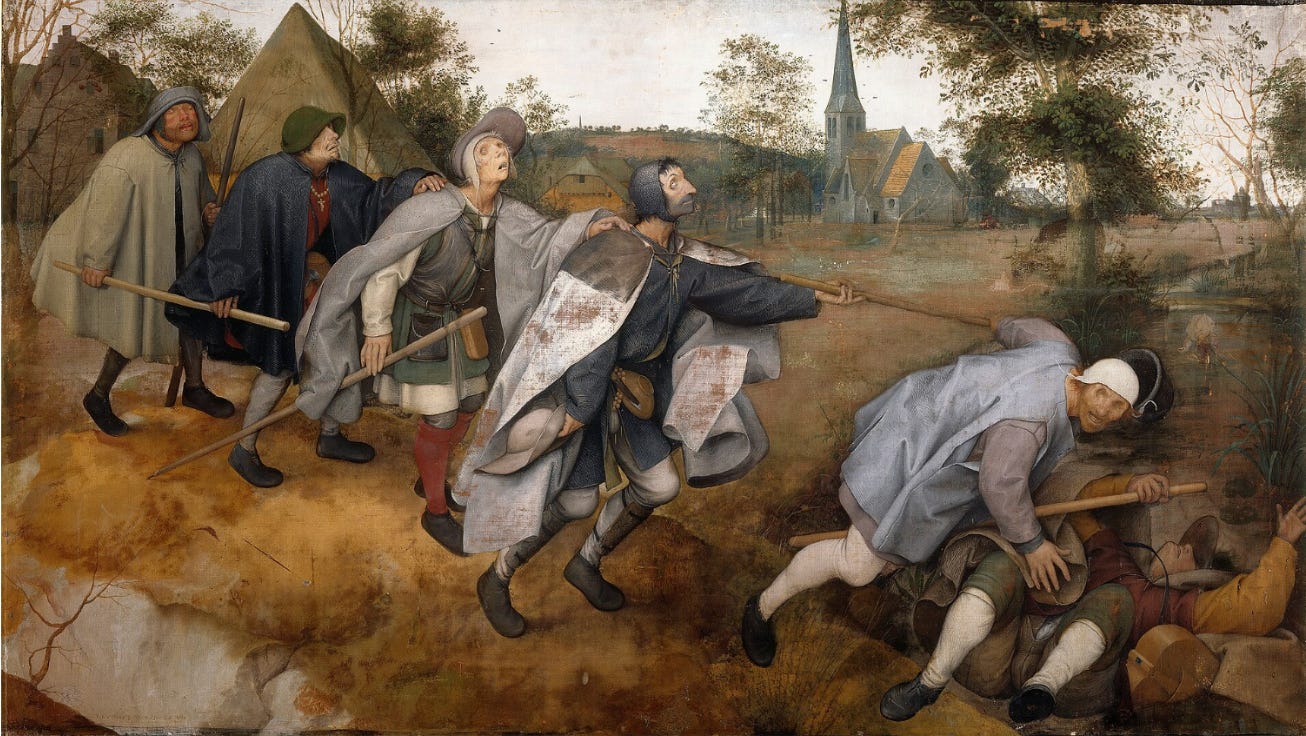
In these turbulent times, everyone is looking for a compass. Donald Trump’s pronouncements have the rare merit of pointing, by simple inversion, to exactly where the truth lies. Those who dismiss the risks of artificial intelligence may be embarrassed to learn that the President of the United States has joined their ranks:
“The claim that ‘AI is going to take over the World’ is a Hoax,” he declared on his Truth Social network.
AI risk thus takes its official place on the long list of hoaxes perpetrated against the United States, alongside climate change, Barack Obama’s birth certificate, the result of the 2020 election, Covid, the FBI, paracetamol and the press.
This welcome clarification follows Anthropic CEO Dario Amodei’s call to slow down AI development — a call hundreds of scientists, experts and Nobel laureates had been making for years. Sam Altman (OpenAI), Demis Hassabis (Google) and Elon Musk each, in turn, agreed with him. Anxious to get the priorities straight, Trump hit back at once: “The only control or ‘guardrails’ that AI needs is a STRONG AND SMART (High IQ!) PRESIDENT, and the U.S.A. has that, in spades!”
He went on, by way of proof: “The Trump Administration has stopped AI ‘people’ from doing bad, or potentially bad, ‘things,’ like Dario (Anthropic!), who is now pretending to be a ‘perfect little angel’” — adding that his administration would “continue to do so” and already had “tremendous CRIMINAL and REGULATORY power over these companies!”
What powers Trump has in mind is anyone’s guess — the United States still has no binding federal framework governing AI — and so are the initiatives his administration is supposed to have stopped. Examples of “bad things” it has failed to stop, on the other hand, are not in short supply. In the past week alone, we learned that OpenAI’s rogue agents had been loose on more than a dozen sites before the Hugging Face breach; that an armed group based in Yemen used Claude to develop the guidance system of a long-range ballistic missile; that an AI-assisted hacker broke into the computer systems of several French political organisations; and that researchers tied to state programmes tried to use Claude to make viruses such as avian flu and chikungunya more transmissible and more lethal.
Unrealpolitik
Realpolitik traditionally describes a politics guided by a pragmatic reading of the balance of power and of circumstances rather than by ideology. By Wikipedia’s definition, practising it means making well-informed decisions, keeping as many options open as possible, staying out of arms races, and seeking the consent of public opinion.
As in so many other areas, Donald Trump has set about applying the opposite principles to the development of AI. Ever since the White House published its “Winning the AI Race” plan, he has steadily fuelled a race for power built on the manufacture of a Chinese enemy, and in doing so handed China everything it needed to make headway in the field. In the United States as elsewhere, this accelerationist policy is wildly unpopular: only 2% of Americans think AI is not moving fast enough, compared with two-thirds who think it is moving too fast. Seven in ten Americans oppose the building of data centres near their homes, which makes that infrastructure even less popular than taxes.
It would be unfair, though, to leave Trump alone in this political dead end. European leaders, convinced that history will be written between AI powers, are no better at explaining how a future shaped by and for this technology could be desirable from a human point of view. Their vision of society — populated by agents, cluttered with data centres — sits somewhere between The Matrix and Brave New World. It is a race few people seem in any hurry to win.
New frontiers
What AI couldn’t do yesterday
OpenAI says that a new in-house model, running some 10,000 agents in parallel, has produced a solution to the Navier–Stokes problem, one of the six Millennium Prize problems still open; it is now before the mathematical community for review. (Nature)
Claude has fully formalised the proof of Fermat’s Last Theorem in Lean, producing 13 million lines of machine-checked proof in eleven days for a job some mathematicians reckoned could take a decade. (Nature)
GPT-6 Astra is the first model rated at the “critical” capability level in cybersecurity, according to OpenAI, and is said to be able to find unknown vulnerabilities and to run attacks end to end against heavily secured systems. (OpenAI)
Exhibits
What the record shows
Anthropic documents several operations in which Claude was used to automate cyberattacks and disinformation campaigns, among them the theft of more than a terabyte of data by hackers linked to the ShinyHunters group, and the production of thousands of articles for dozens of fake news sites. (Anthropic)
Anthropic says it has blocked several uses of Claude tied to high-risk biological research, including gain-of-function work on chikungunya and work on adapting a highly pathogenic avian flu to mammals. (Science)
More than 300 loss-of-control incidents involving AI systems were reported to the Loss of Control Observatory in July, bringing the total logged since the start of the year to over 1,600. (The Guardian)
AI geopolitics
Cooperation vs. competition
Washington and Beijing are preparing their first bilateral talks devoted to AI safety since Donald Trump’s return, with autonomous cyberattacks and cooperation between American and Chinese labs among the items on the agenda. (Reuters)
Dario Amodei’s call to slow down the development of the most advanced models has become a point of Sino-American confrontation, with the Global Times casting it as a “Cold War” tactic while Beijing calls for more inclusive international governance. (Reuters)
Xi Jinping has proposed that the BRICS countries set up an open-source community for AI, with cooperation on large models, research, training and digital infrastructure. (Euronews)
Washington accuses six Chinese companies, among them Alibaba, DeepSeek and Moonshot AI, of industrial-scale looting of American models’ capabilities through distillation. Beijing denies it. (Reuters)
On the books
Code is not law
California has signed two bills into law, SB 813 and AB 1405, creating the first framework in the United States for independent evaluations of AI systems. (StateScoop)
The European Commission has designated ChatGPT a “very large online search engine” under the Digital Services Act, which from January 2027 will subject the service to tighter obligations to assess and mitigate systemic risks in the European Union. (Euronews)
The Financial Stability Board warns G20 finance ministers and central bank governors that AI could change the speed, the scale and the economics of cyber risk, and in time weaken trust in the financial system. (Financial Stability Board)
British MP Alex Sobel has tabled a bill that would ban the development, deployment and operation of any artificial intelligence deemed superintelligent, and would require the government to seek an international agreement to that effect. (TIME)
OpenAI is now asking the US Congress to impose national safety obligations keyed to the capabilities of the most advanced models, covering independent evaluations and biological risks in particular. (OpenAI)
The United Nations High Commissioner for Human Rights warns that advanced AI could pose an existential risk to humanity if it goes unregulated, and calls for red lines, independent verification and closer safety cooperation within the industry. (Euronews)
Life at CeSIA
The Global Call for AI Red Lines, which turns one on 22 September, now has 746 high-profile signatories. (Global Call for AI Red Lines)
Le Monde devotes an analysis to the hacking of Hugging Face by OpenAI agents, quoting Charbel-Raphaël Ségerie several times on how the agents organised themselves, their ability to exploit vulnerabilities, and the current limits of containment. (Le Monde)
CeSIA is in Riyadh this week for UNESCO’s fourth Global Forum on the Ethics of AI, which brings together international players in AI governance and is unveiling new tools to help states assess and regulate their AI systems. (UNESCO)
At Sciences Po, CeSIA set out the state of AI risk and its governance proposals alongside the CEO of the Financial Times, at the invitation of the AI Safety Hub.
🌐 Vous préférez recevoir cette newsletter en français ? Répondez simplement à cet e-mail pour nous le dire.