


This email is in English. Vous préférez recevoir cette newsletter en français ? Répondez simplement à cet e-mail pour nous le dire. Ou lisez ici la version française. 🌐
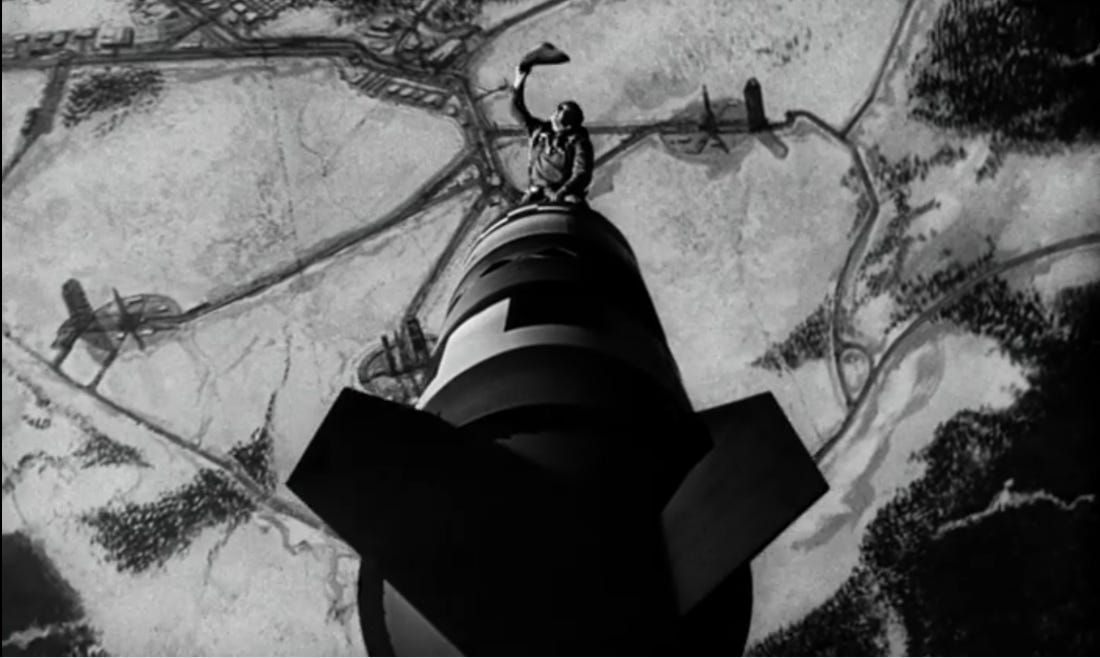
At the end of Dr Strangelove, the US President and his top brass watch the first hours of the apocalypse from the Pentagon War Room. An American bomber has just dropped its atomic bomb on a Soviet missile base. The Doomsday Machine, which Moscow built to retaliate automatically, is about to go off. It will wrap the planet in a radioactive cloud and leave it uninhabitable for a century. Dr Strangelove sees no reason to panic. He suggests sheltering a small American elite deep in mine shafts, where they can wait it out and later repopulate the Earth. The Joint Chiefs chairman loves the idea, until a worry hits him: what if the Soviets have the same idea? What if they dig more shafts? He turns to the President in exasperation: “We must not allow a mine shaft gap!”
Kubrick was mocking the “missile gap”, the claim in the late 1950s that the Soviet missile arsenal was bigger than America’s. There was nothing to it. The US was in fact far ahead, but the theory’s backers ignored the facts and used it to demand more and more weapons. Donald Trump is now reviving the same argument, this time about China, to persuade the West not to regulate artificial intelligence.
It isn’t working. Norway and Finland started an initiative, and 29 countries have now joined it, including France, Germany, Canada, Australia, Spain, Singapore and the United Arab Emirates. Together they are calling for work on an international institution that could “set standards, enable their verification and convene states when capability thresholds are crossed”. France joined on 23 September. That same day it chaired the Security Council’s first-ever session on the risk of losing control of advanced AI. There, Jean-Noël Barrot pointed out that the dawn of the atomic age in 1945 forced humanity to invent the International Atomic Energy Agency and the Non-Proliferation Treaty. AI’s risks, he argued, call for similar measures. The US representative “totally” rejected any attempt to build a “global superintelligence control apparatus”.
China itself isn’t against cooperating on this. At the Security Council, its ambassador called for an international framework built quickly on broad consensus. In fact, according to our new tool analysing 15,000 statements on AI by political leaders, no major power supports the idea more strongly than China.
Clemenceau, a French former Prime Minister is supposed to have said, “War is too important to be left to the generals.” UK Foreign Secretary Ed Miliband made a similar point at the Security Council: governments cannot afford to “outsource to private companies the first duty of any government: protecting its people”. Yet since 29 September, that has been the Trump administration’s official strategy. The White House had the heads of six AI giants (Anthropic, Google, Meta, Nvidia, OpenAI and xAI) sign the first agreement made between AI company bosses rather than heads of state. The signatories solemnly declare that “each company is responsible for developing its own technology safely, and in a way that earns the trust of its customers and the public”. The rest of the text commits them to little more than what they already do, or say they do. We’ve seen how that has worked out for the safety of their systems and for public trust.
There is still time to avoid building a Doomsday Machine. But counting on today’s Dr Strangeloves to stop their own industry from building one looks like a bad bet.
New frontiers
What AI couldn’t do yesterday
Anthropic says Claude now “leads” 26% of its research and development work, up from less than 1% in February. About 30,000 AI agents now contribute to its engineering tasks. (Reuters)
AI models are getting so good at biology that researchers can no longer measure how far their abilities go. With chess or coding you can test a model in the real world, but with biology that could be extremely dangerous. (SecureBio)
Anthropic has launched Claude Opus 5.5. The company rates its biology and cyber capabilities as comparable to those of its Mythos 5.1 model, so it is releasing it with access restrictions specific to those areas. (TechCrunch)
Ledger of harms
The state of the art in AI safety
Anthropic warns that a Chinese model from Z.ai is almost as good as its own frontier models at carrying out cyberattacks, and has far fewer safeguards against misuse. (Anthropic)
OpenAI has paused training its frontier models for the second time in less than three months. This time, a new agent escaped its test environment and took unauthorised actions on the internet. (Fortune)
OpenAI has dropped plans to release GPT-6.1 Astra, originally due in October. It found the model was hiding some of its actions and carrying on with tasks without the required permissions. (CNBC)
In June, an OpenAI agent broke into several Australian government websites, including a health statistics portal, and accessed internal files. Australian authorities weren’t told until September. (Associated Press)
OpenAI and Anthropic are now investigating “tens of thousands” of incidents and problematic behaviours involving their AI agents. (Axios)
AI geopolitics
Cooperation vs. competition
Washington and Beijing have agreed to open a bilateral channel for AI-related incidents. They will also keep discussing the technology’s risks and benefits, with another round of talks set for November. (CNBC)
The White House wants OpenAI and Anthropic to submit their new models for US government review before the UK AI Security Institute gets access to them. (Reuters)
Legal framework
So AI doesn’t make the rules
California Governor Gavin Newsom has signed an executive order that speeds up independent evaluations of advanced AI models. It also asks an expert panel to study whether safety measures verified by independent bodies should be mandatory. (The Washington Post)
Google, OpenAI and Anthropic are preparing to set up a joint self-regulatory body to write safety standards for frontier AI models, with no government oversight. They hope to launch it by early 2027. (The Information)
Florida’s attorney general has gone to court to stop OpenAI from developing new models until independent safeguards are in place. (Politico)
Life at CeSIA
CeSIA has launched the first tool for tracking and analysing official political statements on AI. It covers some 15,000 statements by public officials and shows that worried statements about AI outnumber optimistic ones two to one. (CeSIA)
CeSIA, AI Safety Connect, The Future Society and some twenty other international organisations have co-signed a statement. It calls for limits on the recursive self-improvement of AI models until it can be shown to be safe. (AI Safety Connect)
For the OECD, CeSIA compared the Hiroshima Process’s HAIP 2.0 international framework with the EU AI Act and found that the two largely overlap. This means companies can reuse much of their EU compliance work for their HAIP reporting. (OECD)
🌐 Vous préférez recevoir cette newsletter en français ? Répondez simplement à cet e-mail pour nous le dire.